Completed · LBM verification project · C++17
D2Q9 Lattice Boltzmann Channel Flow
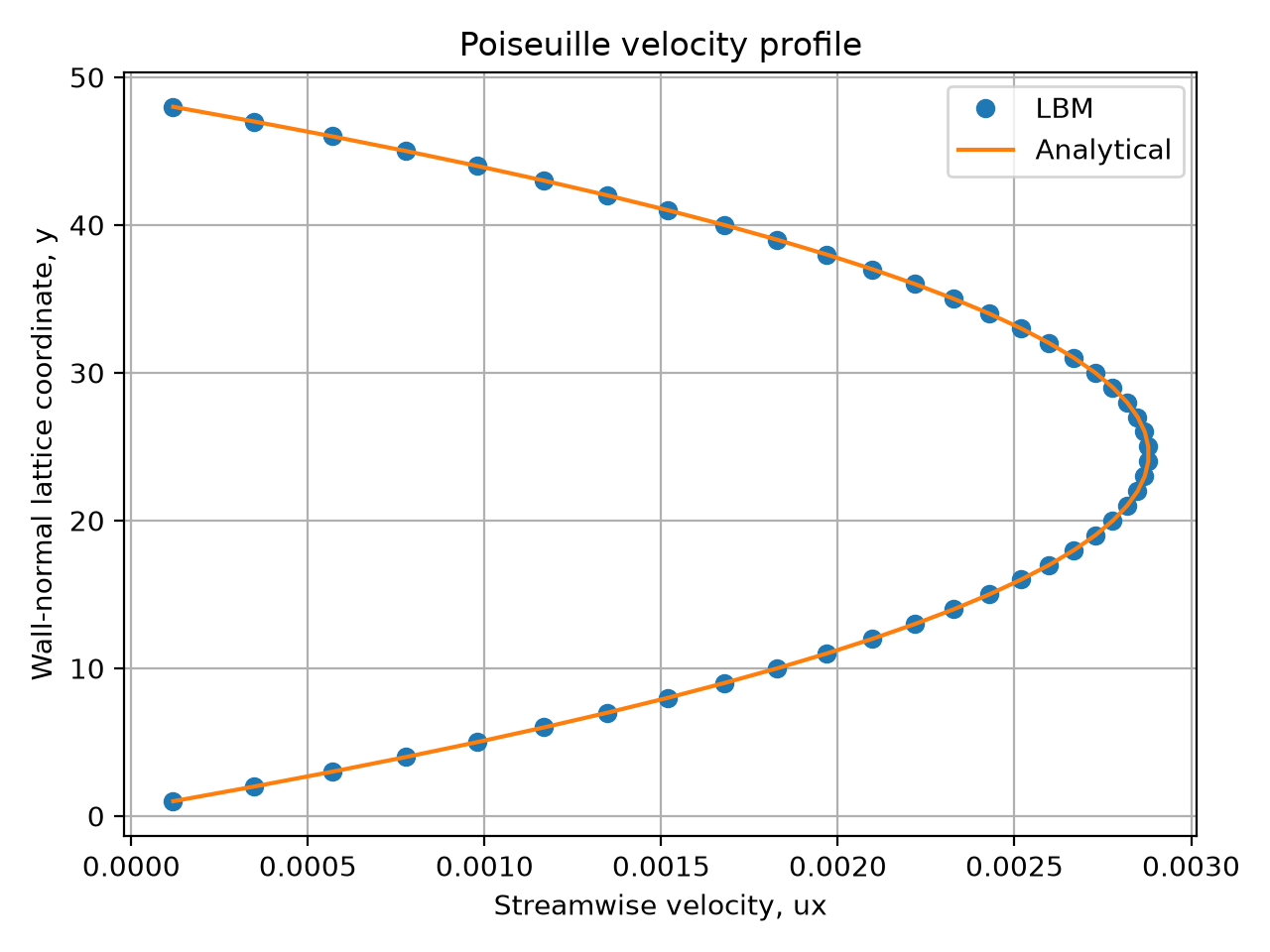
A completed C++17 implementation of the Lattice Boltzmann Method for two-dimensional Poiseuille flow, with the numerical profile compared with the analytical parabolic solution.
Problem
Poiseuille flow is a controlled LBM verification case because the expected velocity profile is known analytically. This makes it possible to check the method and boundary treatment before moving to more complex flows.
Numerical method
Lattice
D2Q9 Lattice Boltzmann model with a BGK single-relaxation-time collision step.
Boundary conditions
Bounce-back treatment at the upper and lower walls with a periodic streamwise direction.
Driving force
A small constant body force drives the channel flow and produces the analytical parabolic profile.
Verification run
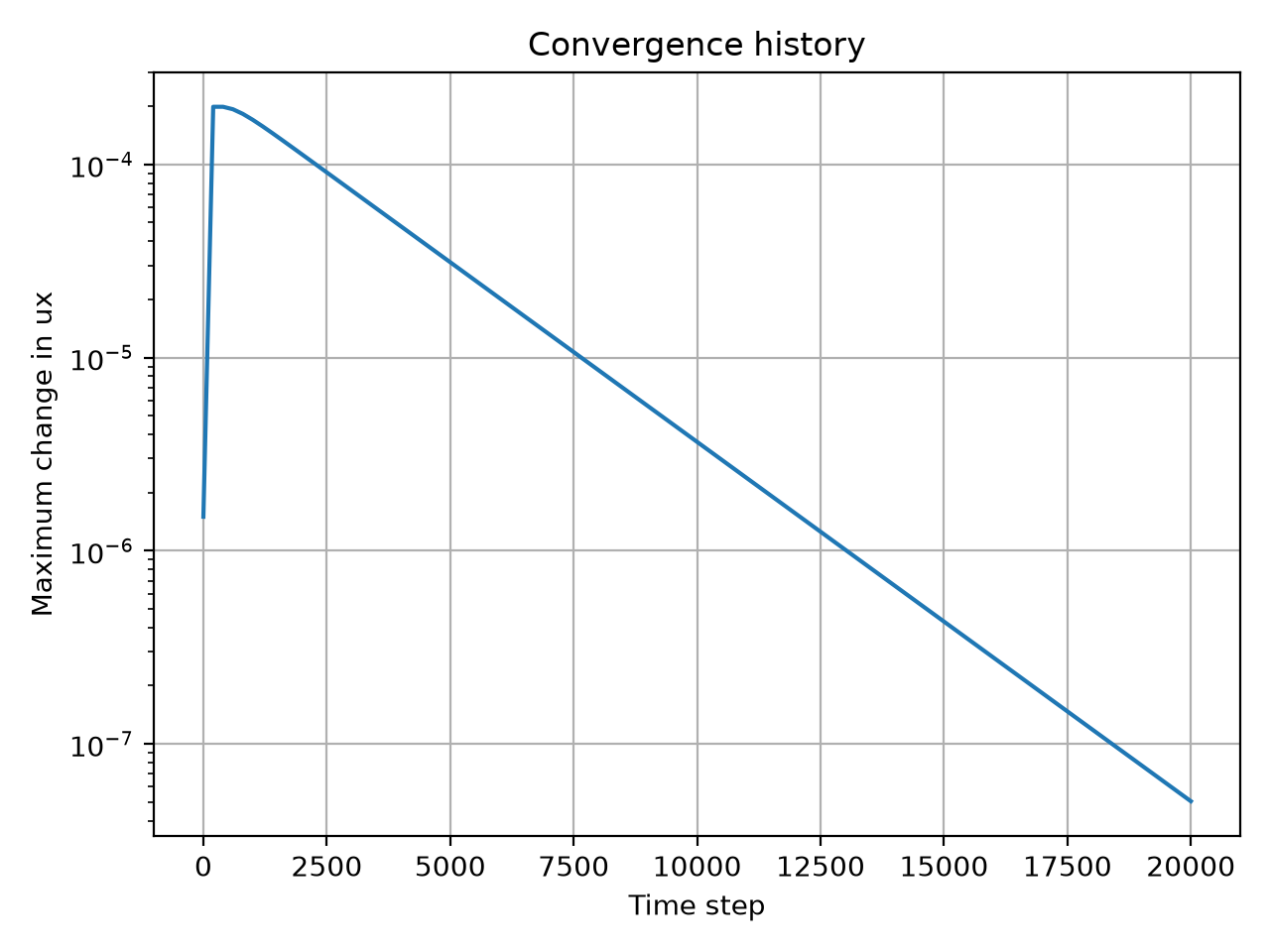
The included figures use nx = 160, ny = 50, steps = 20000, tau = 0.8, forceX = 1e-6, and saveEvery = 200.
Representative results
My contribution
- Implemented the D2Q9 collide-stream workflow in C++17.
- Added body-force-driven flow, bounce-back walls, and periodic streamwise behavior.
- Exported the centerline profile, velocity field, convergence history, and run metadata.
- Added Python post-processing and GitHub Actions CI.
- Kept the repository compact so the numerical method remains easy to inspect.
Completed scope and limitations
The completed project uses a single-relaxation-time BGK model and one channel-flow verification case. It does not include an automated grid-convergence study or parallel implementation. Possible follow-up research includes grid refinement, Reynolds-number variation, MRT collision, and OpenMP or MPI acceleration.